
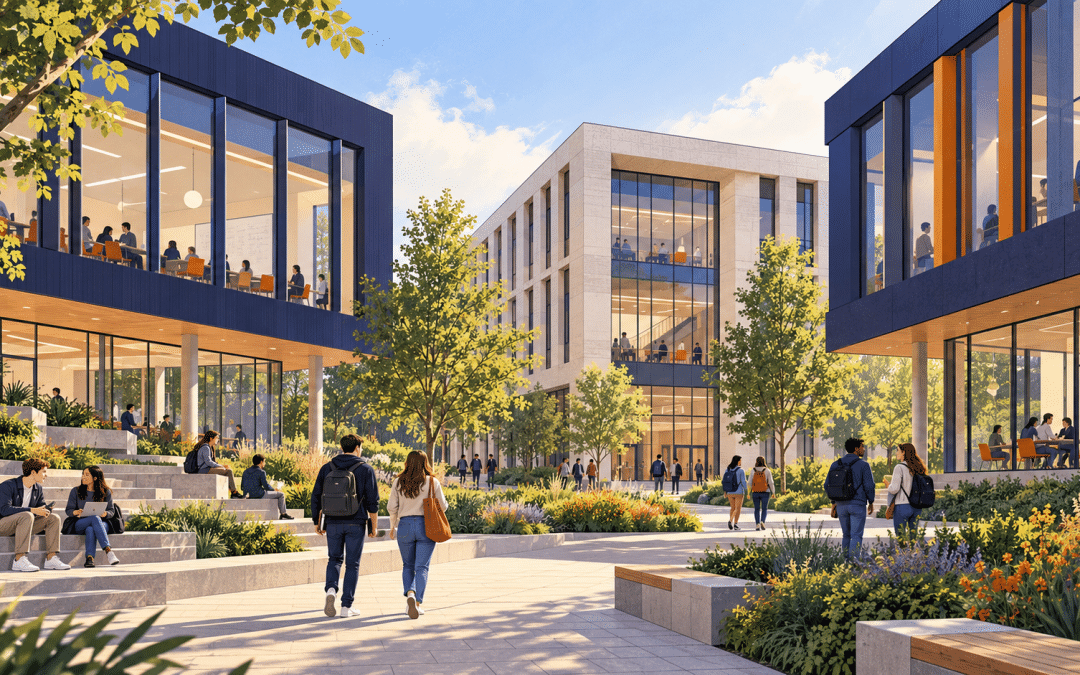
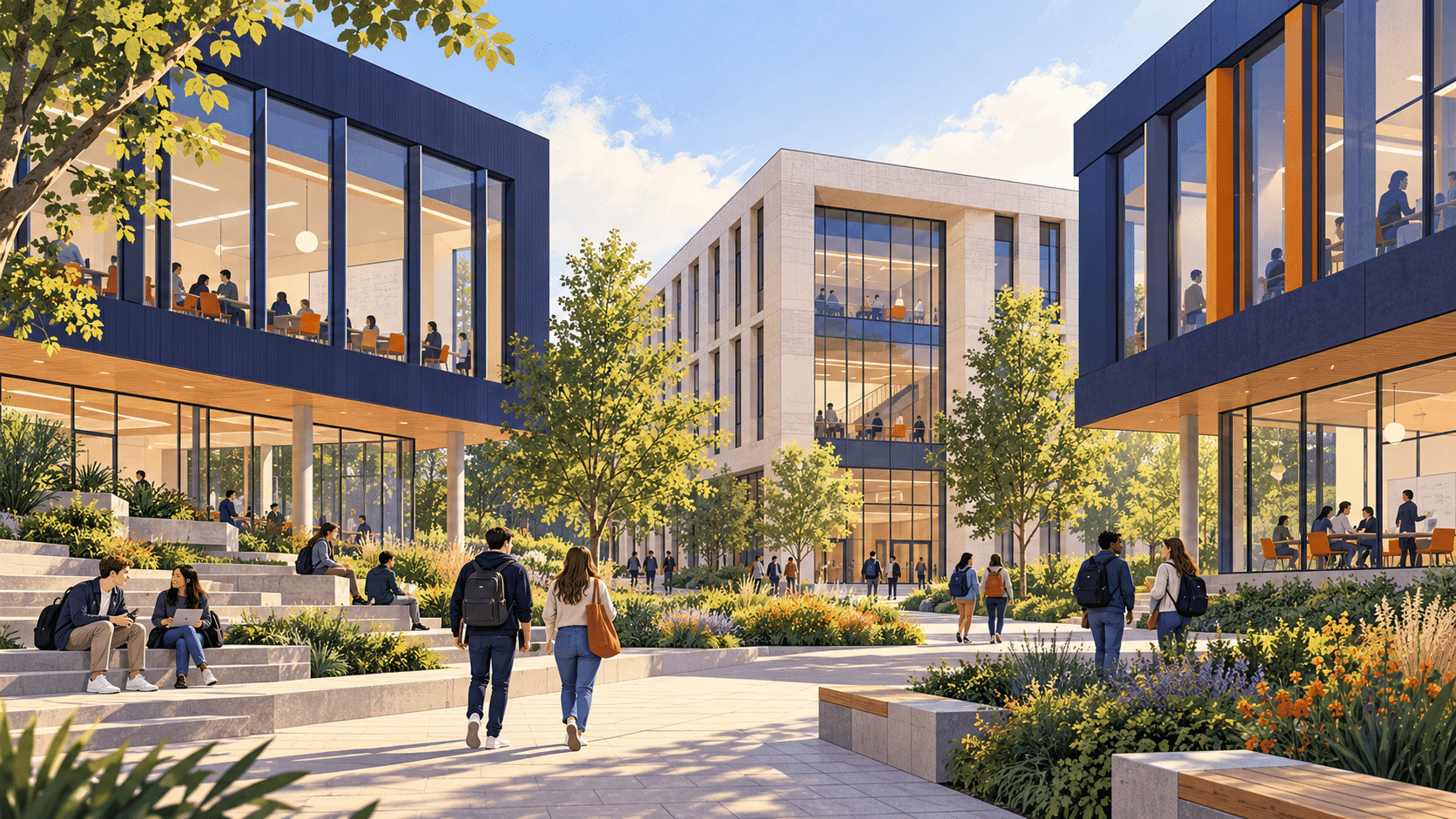
A university timetable tells you what you will study. The spaces around it can reveal how you might learn. At Sheffield Hallam, three buildings opened for the 2025/26 academic year have brought a new mix of specialist teaching, practical facilities and public space to the City Campus. A year on, the Howard Street development is a useful example of a campus evolving with its courses.
Named Langsett, Redmires and Strines after local reservoirs, the buildings connect the project to the wider South Yorkshire landscape. Hallam’s opening announcement described facilities ranging from a Bloomberg trading floor and a moot court to immersive technology. It also introduced Hallam Green, an outdoor area with new trees and seating.
Langsett provides a home for Sheffield Business School, while Redmires brings together social sciences, architecture, and law and justice. Strines includes facilities for the South Yorkshire Institute of Technology. The arrangement puts different kinds of learning within one campus development, while giving departments spaces suited to their particular subjects.
The university’s student-facing guide adds detail to that picture. Architecture facilities include model-making and digital production resources; psychology spaces include specialist equipment for studying areas such as speech and eye movements. These examples help explain what a new academic building can contain beyond lecture theatres, desks and a fresh exterior.
For an applicant, a list of equipment is the beginning of a conversation. Ask how it appears in teaching, which modules use it and what students are expected to make, test or practise. Seeing a specialist room on an open day is more useful when you can connect it to a project you might undertake during the course.
The Howard Street project also has a delivery story. Hallam’s account of the formal opening identifies the Hallam Alliance, bringing together the university with BDP and Arup for design, BAM for construction and CBRE for facilities management. The ceremonial opening took place on 16 October 2025, following the start of teaching in the buildings.
That combination of roles matters because opening day is one stage in a building’s life. The people planning and constructing a space need to consider how it will be operated afterwards. A busy teaching environment has to accommodate changing timetables, specialist equipment and the regular arrival of new students, alongside maintenance and everyday care.
Hallam describes the development as net-zero-ready and highlights features including heat pumps and solar panels. That wording refers to the project’s design ambitions and features; it should be read separately from any later measurement of operational performance. For students interested in sustainability, the next useful questions concern how the buildings are used and how their performance is monitored.
The outdoor spaces are another reason to look beyond the teaching room. A campus visit can include the routes between buildings and the places available for a break. Try the journey at the time you would normally travel, consider where you could eat between sessions and look for somewhere comfortable to wait if your timetable has a gap.
Students moving to Sheffield can use the same approach when choosing a home. Start with the building where your teaching is actually based, then compare travel time and cost from the accommodation you are considering. A city-centre address is useful information, but the daily route between home and a particular department is what you will experience.
New university buildings also give accommodation teams a reason to stay curious about the campuses around them. Knowing where courses are taught helps teams answer practical arrival questions and signpost residents to the university’s current information. It is a small connection between the academic and residential sides of student life, but one that can make a new city easier to navigate.
The Howard Street development offers an upbeat picture of higher education taking physical shape: new facilities for practical learning, space for different subjects and another part of Sheffield to explore. For prospective students, the invitation is straightforward. Look inside, ask how the spaces are used, and imagine the kind of work you could do there.
For accommodation teams: Soniclean’s post-build and turnaround cleaning.
Sources and further reading
- Sheffield Hallam: opening for the 2025/26 academic year (16 September 2025).
- Sheffield Hallam: buildings and teaching facilities (updated 29 August 2025).
- Sheffield Hallam: formal opening event (17 October 2025).
Sources checked on 22 October 2026. The opening dates above refer to 2025.